
What a Commercial Property Surveyor Does Before You Sign
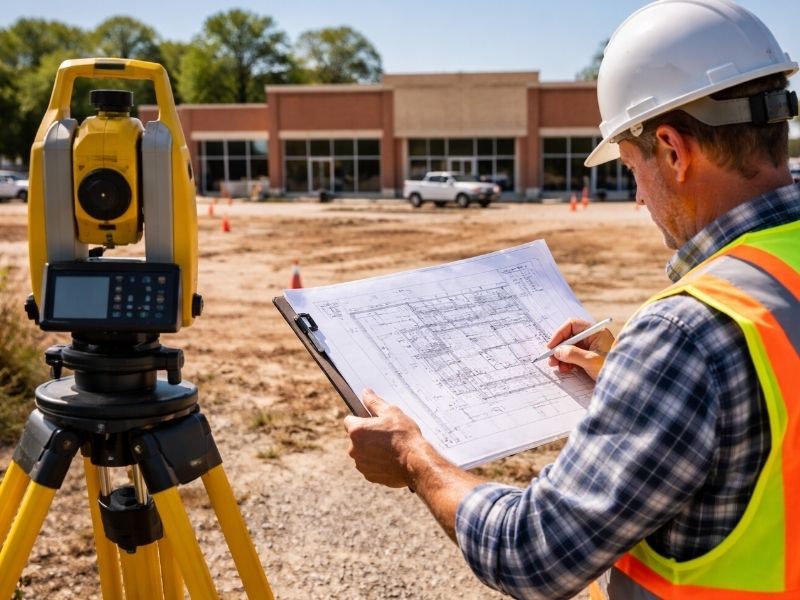
Most developers who’ve been burned on a commercial deal say the same thing. They moved too fast. They signed before a commercial property surveyor could look at what was on, under, or crossing that parcel. What looked clean on paper wasn’t.
A commercial property surveyor isn’t a formality. What they do before closing shapes every decision that follows.
What the Job Actually Covers
A commercial property surveyor looks at the physical and legal condition of a parcel before a deal closes. This is not just drawing lines on a map.
They pull records, visit the site, take measurements, and produce a signed, sealed report. That report tells buyers, lenders, and title companies exactly what they’re dealing with. Commercial properties carry more risk than residential ones. Larger parcels, complex ownership histories, zoning issues, utility corridors, and shared access agreements all create problems that a deed description won’t show.
Records Research Comes First
Before a commercial property surveyor visits the site, they pull records.
That means deeds, prior surveys, plats, easement agreements, and right-of-way documents. They look for gaps, overlaps, and anything that conflicts with what the seller says is being sold.
This step catches problems a site visit alone would miss. An easement recorded thirty years ago won’t show up as a physical marker. A gap in the chain of title won’t announce itself at the property line. Records research is where those issues come up.
Why Buyers Skip This Step (And Pay for It Later)
Some buyers push surveyors to skip deep research and just do a quick field visit. That’s a bad trade. A field visit without records research only shows what’s visible on the ground. It tells you nothing about what’s legally tied to the land.
Title companies won’t insure over unresolved record conflicts. Lenders won’t fund. If those issues show up after signing, they become the buyer’s problem.
What a Commercial Property Surveyor Checks on Site
Once records research is done, the surveyor visits the property. On a commercial parcel, that visit covers more ground than most buyers expect.
They locate boundary monuments. They measure the parcel and compare those measurements against the legal description in the deed. Any gap between what’s recorded and what’s physically there gets flagged.
They also document all visible improvements: buildings, parking areas, paved surfaces, fences, retaining walls, signage, and utility structures. They note where those improvements sit relative to the boundary lines. If anything crosses onto a neighboring parcel, that gets flagged too.
Encroachments and Why Developers Should Care
An encroachment on a commercial property can stop a project cold.
If a neighboring structure sits inside your parcel, you have a title problem. If your site’s existing improvements cross into an adjacent property, same issue. Title companies will require resolution before insuring the deal. That resolution might mean a boundary line adjustment, a legal agreement with the neighbor, or tearing down the encroaching structure.
Finding an encroachment after signing means you negotiate from a weak position. A commercial property surveyor finds it before closing, when you can still act on it.
Easements: The Risk Most Developers Underestimate
Easements give another party the legal right to use part of your property. Utility companies, municipalities, neighboring owners, and government agencies can all hold easement rights over a commercial parcel.
A commercial property surveyor locates and maps every easement on the site. Common types include:
- Utility easements for power lines, water mains, sewer lines and gas pipelines
- Drainage easements that block grading or construction in low-lying areas
- Access easements that let neighboring parcels cross your site
- Conservation easements that limit what you can build on portions of the land
Every easement limits what you can build and where. A developer who designs a building footprint without knowing where the easements fall will likely need to redesign. Sometimes by a lot.
Zoning and Setbacks
A commercial property surveyor checks zoning classifications and maps setback lines onto the survey. Setbacks define how close to a boundary line a structure can legally sit.
This is most important for redevelopment projects. An existing building may already sit inside a current setback. That creates a nonconforming condition. It affects whether you can expand the building, what permits you can pull, and what happens if the structure is damaged or demolished.
Knowing the setback picture before signing gives you a realistic view of what the site can actually support.
What the Final Survey Document Shows
The output is a scaled drawing with a written legal description. It’s signed and sealed by a licensed surveyor. It shows parcel boundaries, measurements, easements, improvements, encroachments, and any conflicts between the recorded documents and the field findings.
Lenders require it. Title companies use it to decide what they’ll insure. Your design team uses it as the legal base for site planning.
A survey without a seal from a licensed professional won’t be accepted for any of those purposes. Make sure you’re ordering from someone licensed in the state where the property is located.
Frequently Asked Questions
When should a commercial property surveyor be hired?
Order the survey within the first two weeks of due diligence. Commercial surveys can take two to four weeks, and complex parcels take longer. Ordering late gives you less time to review findings and fix problems before closing.
Does a commercial property survey expire?
There’s no built-in expiration date, but lenders and title companies often require a survey dated within six months to a year of closing. If conditions on the site or nearby parcels have changed, a new survey is usually required regardless of when the last one was done.
What’s the difference between a commercial survey and an ALTA survey?
An ALTA survey follows national standards set by the American Land Title Association and the National Society of Professional Surveyors. It’s the most detailed survey type used in commercial deals and is built to meet the requirements of title insurers and institutional lenders. Not all commercial surveys meet ALTA standards. If your lender or title company requires one, confirm that before ordering.
Can the seller’s existing survey be used at closing?
Sometimes, but rarely without conditions. The survey must be current and certifiable to the buyer and lender. It also can’t have been affected by any changes to the property or adjacent parcels. A licensed surveyor can review it and tell you whether it can be re-certified or whether a new one is needed.
What happens if the surveyor finds a problem?
Minor discrepancies may be resolved with a title endorsement. Encroachments may need a legal agreement or boundary adjustment. Serious title defects may be grounds to renegotiate the price or walk away. Finding problems before signing gives you options. Finding them after doesn’t.
For a free land surveying quote, call us at (727) 295-4195 or send us a message by going here.
Posted in land surveying, land surveyor |