
Neighbor Rejecting Your Boundary Survey? Here Is What to Do
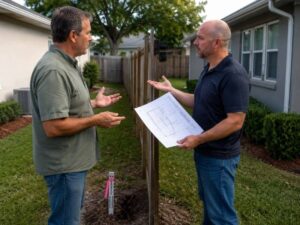 You paid for a professional boundary survey. The licensed surveyor did the work. The plat is in your hand. And your neighbor still refuses to accept it.
This situation is more common in St. Petersburg than most people realize, and it can feel incredibly frustrating when you have done everything right and still hit a wall. Here is what is actually going on, why it happens, and what your real options are.
Why Would a Neighbor Reject a Boundary Survey?
A neighbor may reject a boundary survey because they do not trust the results, believe a previous survey was more accurate, or simply do not want to accept that a fence, driveway, or structure is on the wrong side of the line. Their objection does not make the survey invalid.
There are a few common reasons this plays out:
- They have a different survey. Older properties sometimes have multiple surveys on record, and if the results conflict, a neighbor may point to the one that favors them.
- They believe the markers are wrong. If an iron pin or monument was disturbed over the years, a neighbor may argue the surveyor found the wrong starting point.
- They are emotionally attached to the land. In older neighborhoods, families sometimes occupy the same home for generations. What feels like “their” land can be hard to let go of, even when the paperwork says otherwise.
- They are stalling. Some neighbors hope that if they wait long enough, the dispute fades away or becomes too costly to pursue.
Understanding why they are pushing back helps you decide what to do next.
Does a Boundary Survey Hold Up Legally?
Yes. A boundary survey completed by a licensed land surveyor is a legally recognized document. A neighbor’s verbal disagreement does not override it. However, a survey is evidence, not an automatic court order. Resolving the dispute may still require additional steps.
A licensed surveyor in Florida is regulated by the Florida Board of Professional Surveyors and Mappers. They are legally responsible for the accuracy of their work and must follow strict state standards. That gives the survey real legal weight.
That said, a neighbor’s objection does not disappear just because you have a piece of paper. Florida courts treat a boundary survey as strong evidence, but if a dispute ends up in litigation, a judge will look at all available evidence, including historical records, deed language, and the physical condition of the land.
What Are Your Options When a Neighbor Refuses to Accept the Results?
Your options in order of cost and escalation are: open a direct conversation, send a written notice, try mediation, file a quiet title action, or pursue litigation. Most disputes are resolved before reaching a courtroom.
Talk First
Before anything else, have a calm, direct conversation. Share the survey plat and walk through it together. Many neighbors reject results simply because they have never seen the actual document. In a lot of cases, seeing the official drawing, the measurements, and the surveyor’s certification is enough to move things forward.
Send a Written Notice
If talking does not work, put your position in writing. A simple letter referencing the survey, the encroachment, and a requested action creates a paper trail. It also signals that you are serious without immediately escalating to legal action.
Try Mediation
Florida courts encourage mediation before litigation for property disputes. A neutral third party helps both sides reach an agreement without a judge. It is faster, cheaper, and far less damaging to a neighborly relationship than a lawsuit.
File a Quiet Title Action
If all else fails, a quiet title action is a lawsuit that asks a court to officially declare who owns the disputed strip of land. Courts rely heavily on survey evidence in these cases. This route takes time and money, but it produces a legally binding result.
What Happens If You Do Nothing?
Doing nothing carries real risk. If a neighbor openly uses a portion of your land for 7 or more years without your objection, they may be able to claim ownership through adverse possession under law.
This is not a technicality. It has happened to homeowners who assumed the situation would sort itself out. The moment you have a survey in hand showing an encroachment, the clock matters. Documenting the dispute in writing, even informally, helps protect your claim.
Two Things That Make This Harder
Older neighborhoods like Historic Kenwood, Roser Park, and Shore Acres present specific challenges. Lots are small, homes are close together, and original survey monuments from decades ago are sometimes missing, disturbed, or buried under years of landscaping. When physical evidence on the ground is ambiguous, disputes get more complicated.
This is exactly why getting a current boundary survey from a surveyor who knows records is so important. Local knowledge of how these older plats were drawn and recorded makes a real difference in the quality of the result.
Frequently Asked Questions
Can my neighbor get their own survey to challenge mine?
Yes. A neighbor has the right to commission their own boundary survey. If the two surveys conflict, the discrepancy will need to be resolved, either through negotiation, mediation, or a court proceeding. Two surveys disagreeing does not mean both are equally valid. The quality of research, evidence used, and experience of the surveyor all matter.
Can I remove an encroaching fence or structure myself?
Not without legal risk. Even if your survey clearly shows a fence is on your property, removing it yourself without a legal agreement or court order could expose you to liability. Get legal advice before taking any physical action.
Does homeowner’s insurance cover boundary disputes?
Generally no. Standard homeowner’s insurance does not cover property line disputes. Title insurance may provide some protection depending on your policy, which is another reason to review your coverage before a dispute escalates.
For a free land surveying quote, call us at (727) 295-4195 or send us a message by going here.
Posted in land surveying, land surveyor |